

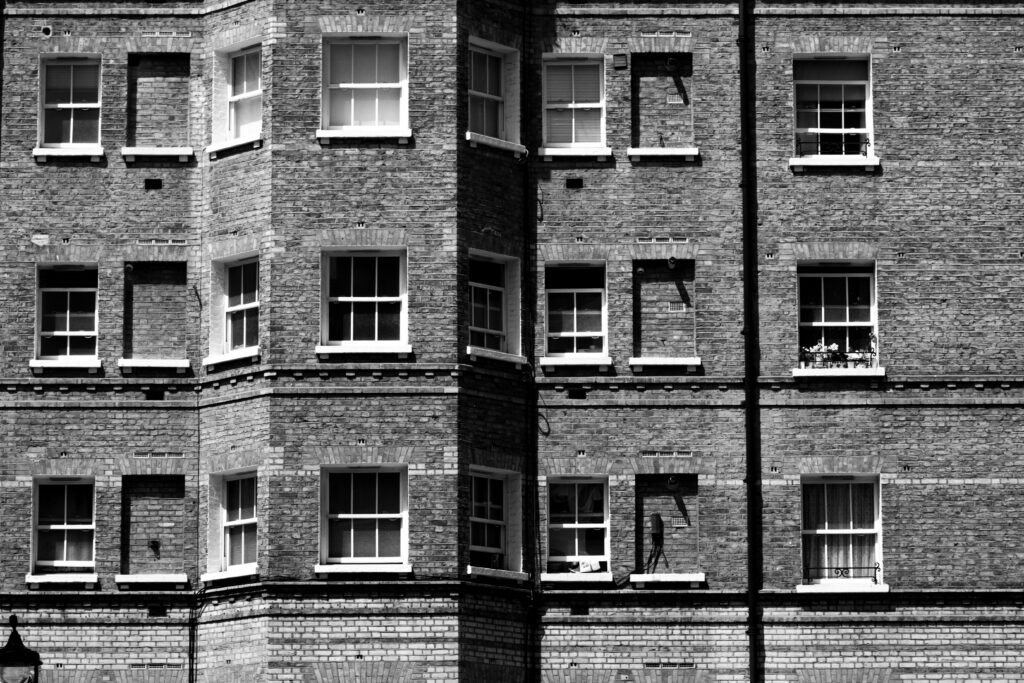
Why Structural Inspections Are the Best Defence for Local Authorities and Housing Associations
Local Authority housing officers and Housing Association asset managers carry a significant legal burden. Thousands of properties, ageing stock, competing capital works priorities, and a growing volume of disrepair claims — all managed against a backdrop of tightening budgets and increasingly assertive tenants’ rights legislation.
At the centre of this landscape sits Section 11 of the Landlord and Tenant Act 1985. Not as a technicality, but as a live and enforceable obligation that carries real financial and reputational consequences when it is not taken seriously — and it applies equally to Local Authorities and Registered Providers, including Housing Associations.
This article sets out what Section 11 actually requires of social housing landlords, why structural condition sits at the heart of compliance, and how independent RICS surveyor inspections provide the evidence base needed to prioritise capital works and defend against claims.
What Section 11 Actually Requires
Section 11 of the Landlord and Tenant Act 1985 implies a repairing covenant into virtually every qualifying residential tenancy. It applies universally — to private landlords, Local Authorities, and Housing Associations alike. It cannot be excluded by the tenancy agreement, regardless of what that agreement says.
Under Section 11, the landlord is required to:
- Keep in repair the structure and exterior of the dwelling, including walls, roof, gutters, drains, and external pipes
- Keep in repair and proper working order all installations for the supply of water, gas, and electricity
- Keep all sanitation installations in repair, including basins, sinks, baths, and toilets
- Keep in repair all installations for space heating and hot water
For tenancies granted on or after 15 January 1989, which encompasses the vast majority of both Local Authority and Housing Association portfolios, those obligations extend beyond the individual dwelling to any part of a building in which the landlord has an interest, where disrepair affects the tenant’s enjoyment of their home or the common parts. Structural failures in a block’s fabric, communal stairwells, roof voids, and shared services are all within scope.
Crucially, the obligation is not triggered solely by a formal tenant complaint. A landlord can be deemed to have knowledge of a defect following any inspection of the property, by a housing officer, a contractor, or a surveyor. Once awareness is established, the clock is running.
The Legislation Has Teeth … and It Is Being Used
Section 11 is not a passive piece of legislation. Tenants can bring claims in the county court for disrepair, and the court can order repairs to be carried out as well as awarding compensation for inconvenience, discomfort, and damage to personal property caused by the breach.
The legal landscape has hardened considerably in recent years. The Homes (Fitness for Human Habitation) Act 2018 supplemented Section 11 by requiring that properties are fit for human habitation at the start of and throughout the tenancy. Assessment is made against the Housing Health and Safety Rating System (HHSRS), covering hazards including damp and mould, excess cold, structural collapse risk, and a range of other structural and environmental factors.
More recently, Awaab’s Law, arising from the tragic death of two-year-old Awaab Ishak in December 2020 following prolonged exposure to mould in a social rented property, introduced mandatory timeframes for addressing hazards in the social rented sector. Where a hazard is caused by a structural defect or deficiency, the landlord is responsible for addressing the root cause. Inadequate insulation, absent ventilation, or poor design are not tenant problems, they are structural ones, and they fall squarely on the landlord.
The consequences of non-compliance extend beyond individual claims. In one widely reported period, eight UK Housing Associations were downgraded by the regulator as a result of alleged breaches of repairing obligations and failure to meet the Homes and Communities Agency’s value for money standard. Regulatory downgrading carries lasting reputational and financial implications that go well beyond the cost of any individual repair.
The regulatory and litigation environment is demanding evidence-based management of housing stock. An assertion that a property ‘appeared satisfactory’ is no longer adequate.
Why Structural Condition Is the Critical Variable
A blocked drain or a broken boiler is straightforward: it is reported, it is repaired, the record is updated. Structural disrepair is considerably more complex.
Structural defects often manifest slowly. Cracking in brickwork, movement in foundations, failing lintels above window and door openings, deteriorating wall ties in cavity construction, inadequate roof structure, and moisture ingress behind internal finishes can all be present for years before a tenant experiences the consequences — a ceiling collapse, a structural crack that opens visibly, or chronic damp that resists repeated attempts at surface treatment.
Because the mechanism is slow and the early indicators are easy to overlook or misread, structural disrepair is the category most likely to generate a significant claim, and the category where both Local Authorities and Housing Associations are most exposed if their evidence of inspection and assessment is inadequate.
The courts do not expect social housing landlords to anticipate every failure. They do expect them to have a credible, documented approach to identifying, recording, and prioritising structural condition across their stock.
What a RICS Structural Disrepair Inspection Provides
A RICS-qualified building surveyor brings a level of technical depth to a structural inspection that general property management processes are not designed to replicate. When Cube’s surveyors carry out a Structural Disrepair Inspection, the assessment is thorough and systematic.
The inspection examines the structural integrity of the building fabric: foundations and substructure, wall construction and condition, roof structure and coverings, floors, ceilings, and internal load-bearing elements. It assesses drainage runs and external envelope condition. It identifies defects that are latent as well as those that are already presenting.
Critically, the resulting report does more than list defects. It:
- Categorises findings by severity and urgency, aligned with HHSRS hazard classifications
- Provides an evidence-based opinion on whether the condition constitutes a breach of Section 11 obligations
- Identifies the root cause of defects, distinguishing, for example, between a damp problem caused by lifestyle condensation and one caused by a structural failure in the building envelope
- Provides a documented basis for capital works prioritisation, so limited budgets are directed where the legal and physical risk is greatest
- Creates an auditable record that demonstrates due diligence — a powerful defence in any subsequent disrepair claim
The Capital Works Priority Problem
Every social housing team, whether in a Local Authority or a Housing Association, faces the same pressure: more properties requiring attention than the capital budget can address in a single programme. The question is never ‘should we repair this?’, it is ‘which properties need attention first, and what does the evidence say?’
Without independent structural inspection, that prioritisation is necessarily subjective. It relies on housing officer observations, tenant complaints, and contractor reports — all of which have value, but none of which provides the technical depth or legal weight of a RICS assessment.
With a structured inspection programme, the capital works decision-making process becomes defensible. You can demonstrate to councillors, board members, auditors, and — if necessary — a court, that the prioritisation of your maintenance programme was based on competent professional assessment of condition and risk.
This is not simply good practice. In the current regulatory and litigation climate, it is prudent risk management.
Defending Against Claims of Structural Neglect
Disrepair claims against social housing landlords have increased significantly in recent years, and the costs extend well beyond the value of any repair. Legal costs, compensation payments, adverse publicity, and the management time consumed by litigation all represent a substantial drain on resources.
The single most effective defence against a claim of structural neglect is evidence. Specifically: evidence that the landlord was aware of its obligations, that it inspected its stock to a competent standard, that it identified structural defects, and that it took appropriate and timely action.
A RICS Structural Disrepair Inspection report provides exactly that evidence. It is a professional, independently produced document prepared by a qualified surveyor operating under the standards of the Royal Institution of Chartered Surveyors. It carries authority in correspondence with tenants’ solicitors, and it carries authority in court.
Equally, where a tenant’s claim overstates the condition of a property, or attributes defects to the landlord that are properly the result of the tenant’s own actions, a robust inspection report is the basis on which those claims can be robustly challenged.
A Proactive Approach Pays for Itself
The case for a structured programme of RICS structural inspections is not solely one of legal risk management. It is also one of long term asset stewardship.
Early identification of structural defects reduces remediation costs. A lintel crack addressed when it first appears is a fraction of the cost of the structural repair required once water ingress has progressed. A roof tie replaced on a planned basis costs less than emergency works following partial failure. A damp problem traced to its structural root cause, and fixed at that level, does not recur annually.
For organisations managing stock that is, in many cases, decades old and approaching the end of design life for several structural elements, the value of professional, periodic assessment is clear. This is as true for a Housing Association managing a mixed urban portfolio as it is for a Local Authority overseeing a large estate.
How Cube Building Consultancy Can Help
Cube Building Consultancy is a RICS-regulated building surveying practice working with Local Authorities and Registered Providers, including Housing Associations, across the UK. Our Structural Disrepair Inspections are designed specifically for the social housing sector, combining technical rigour with a clear understanding of the regulatory and legal framework in which housing professionals operate.
Whether you require a single high-priority inspection, a batch assessment programme, or a planned rolling stock condition survey, our surveyors provide Court ready reports that are thorough, clearly written, and built to withstand the toughest scrutiny.
If your housing stock needs dependable structural assessment, or if you are facing a disrepair claim and require independent professional opinion, we would welcome the opportunity to discuss how Cube can support your team.
Contact Cube Building Consultancy to learn more about our Structural Disrepair Inspections for Local Authorities and Housing Associations.
Cube Building Consultancy is a RICS-regulated practice. All structural inspections are carried out by qualified Chartered Surveyors.
